
.png)
Note: If you’re wondering WTF an ETF is, click here.
The good news - The most popular global shares ethical ETFs on the ASX don’t invest in companies that make fighter jets, nuclear missiles, guns and other military-grade weapons
The bad news - No global shares ethical ETF is perfect. They invest across the global economy and inevitably some of these companies have ties to militaries and weapons. However, there are clear differences between the 3 most popular ones available on the ASX.
While you may not be able to find a fund that perfectly aligns with your ethics , you should be able to find one that lets you sleep at night knowing your investments match your values.
Most ETFs are invested in companies making weapons, or providing services to militaries. They invest broadly across the economy and don’t use ethical screens.
But some ethical ETFs also invest in these companies. The weapons industry is involved in many economic sectors (especially tech, communications, and manufacturing), and looking closely at the ethical screening rules of some of the ASX’s biggest ethical ETFs reveals many are more invested in the military-industrial complex than assumed.
Investments in weapons and military services is much more relevant for ethical International shares ETFs than ethical Australian shares ETFs, as most weapons companies are based in the US, EU and Japan.
The ASX offers several popular ethical ETFs that invest in international companies. each with different levels of exposure to the military and weapons.
To help you choose the one that best fits your values, SIX looked at the 3 most popular ethical ETFs on the ASX and assessed:
Let's look at an ETF through an analogy of an onion. By peeling back the layers, we can see exactly how "deep" each fund’s screens and investments go.
Layer 1: The outer skin - Weapons
This includes companies like Boeing or Lockheed Martin that manufacture missiles and nuclear warheads.
A standard US fund like IVV (S&P 500) sits right here, with large direct exposure to weapons and military contractors.
The good news is ethical ETFs ETHI, ESGI, and IWLD all successfully peel this core layer away, generally excluding direct manufacturers of civilian, controversial and nuclear weapons.
Layer 2: The Inner Skin - Dual-Use Components
As we peel deeper, we find companies making "ingredients" for the military like GPS systems, specialized glass, paint and sensors.
Semiconductor manufacturer Infineon and car companies like Ford, Renault fall into this category.
Layer 3: The Core - Services
This is the least visible layer. It involves everyday tech but modified specifically for the military or weapons — think cloud computing, 5G, and AI— that is used by militaries for surveillance, data warehousing, or logistics.
Companies like Palantir, Google and Microsoft fall into this category.
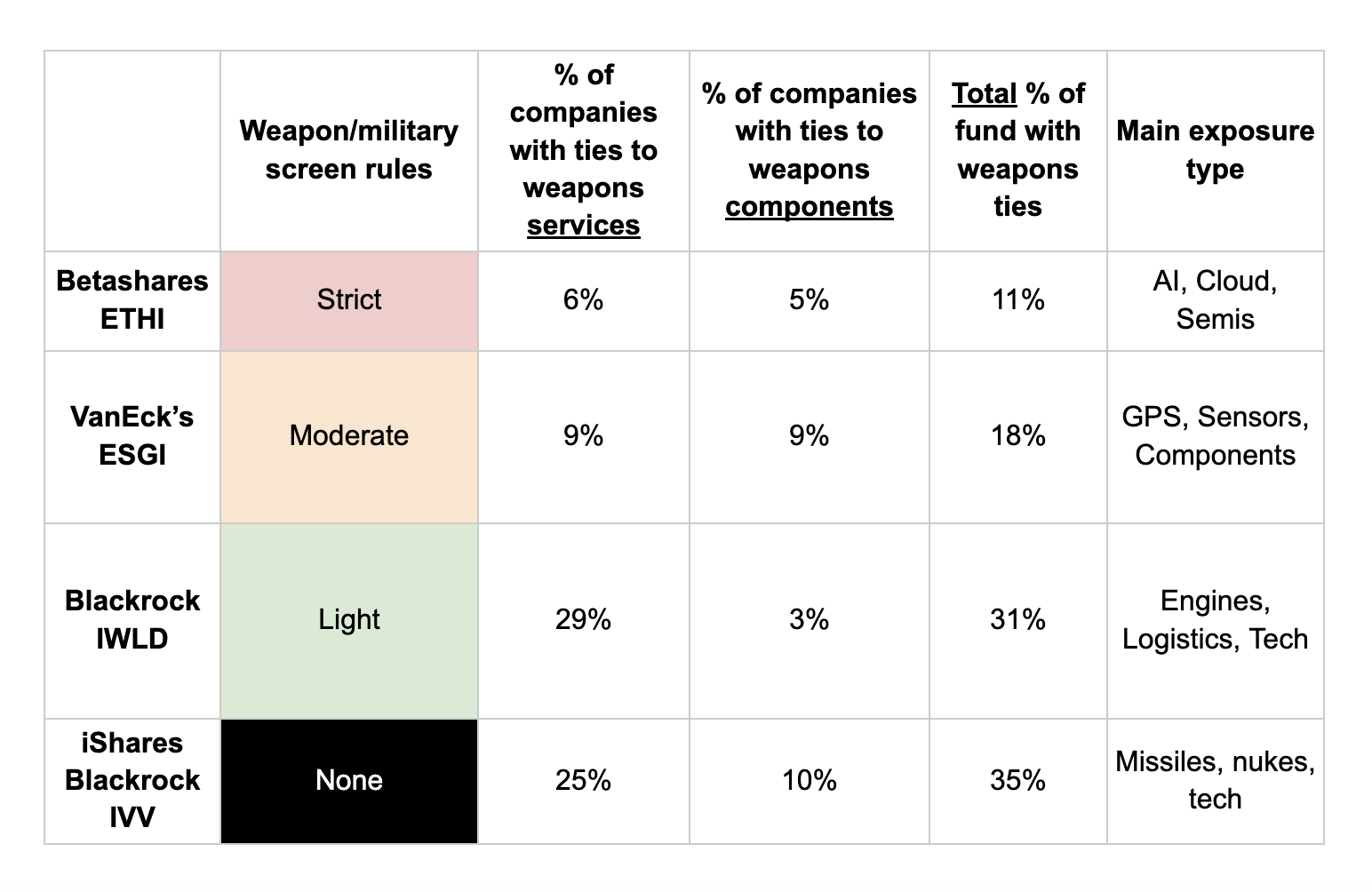
There is no wrong choice here; these ethical ETFs are all significantly less invested in the military-industrial complex than any ETF with no ethical screens.
While you may not be able to find a perfect fund, you should be able to find one that lets you sleep at night knowing your investments match your values.
It’s important to distinguish between market cap (here we mean the market value of a company that has any ties to weapons/militaries) and revenue (how much money the company earns from weapons and military services).
When we say in this blog that "31% of a fund has military ties," it doesn’t mean 31% of your money is investing in missiles. It means that companies that earn any revenue from manufacturing or services to weapons/militaries account for 31% of the ETF’s market capitalisation.
Imagine a furniture maker. It sells 1,000 chairs a day. If one of those chairs is sold to a military base, is it an essential military contractor? Probably not.
What if half the seats it makes are specifically made for fighting jets and to withstand extreme conditions, then we say this is an essential military contractor.
Interested in going deeper? Send us an email and we'll provide you with some extra research
Start your journey in ethical investing and make a positive impact as a shareholder.