

At SIX we create positive change by using the power of shareholders to advocate for ASX-listed companies to protect ecosystems and wildlife, treat their workers better, and address other big challenges we face.
To do this, we need to find 100 shareholders to file a resolution (a formal item that is voted on by all shareholders) at the company Annual General Meeting (AGM).
The AGM is one of the main chances investors get to spotlight the issue and put the company directors and their senior managers under scrutiny.
So, how does it all play out?
First we have to file the resolution with the company and then we need to convince the investors to support us.
Well, the 100 investors who file our resolutions are regular investors like you and me who commonly own a small amount of company stock, often $500-1000 each ($500 is the minimum amount you can invest on the ASX).
But for a company worth $40 billion, with thousands of investors, that’s a tiny fraction of the company’s stock. So once we’ve put the issue on the agenda with a resolution we then aim to encourage shareholders who together own at least 20% of the company to support us. That means convincing the large ‘institutional investors’ who own millions of dollars of shares to support us.
Institutional investors include the world’s sovereign wealth funds, endowments, foundations, banks, and insurance companies and own roughly $70 trillion of assets, half of which is by pension funds / superannuation funds! This means they can play a huge role in supporting resolutions and building relationships with institutional investors can be crucial to the success of a resolution.
Australia is a small population with a large super industry, worth AUD $4.2 trillion. This makes our super funds important arbiters of corporate behaviour.
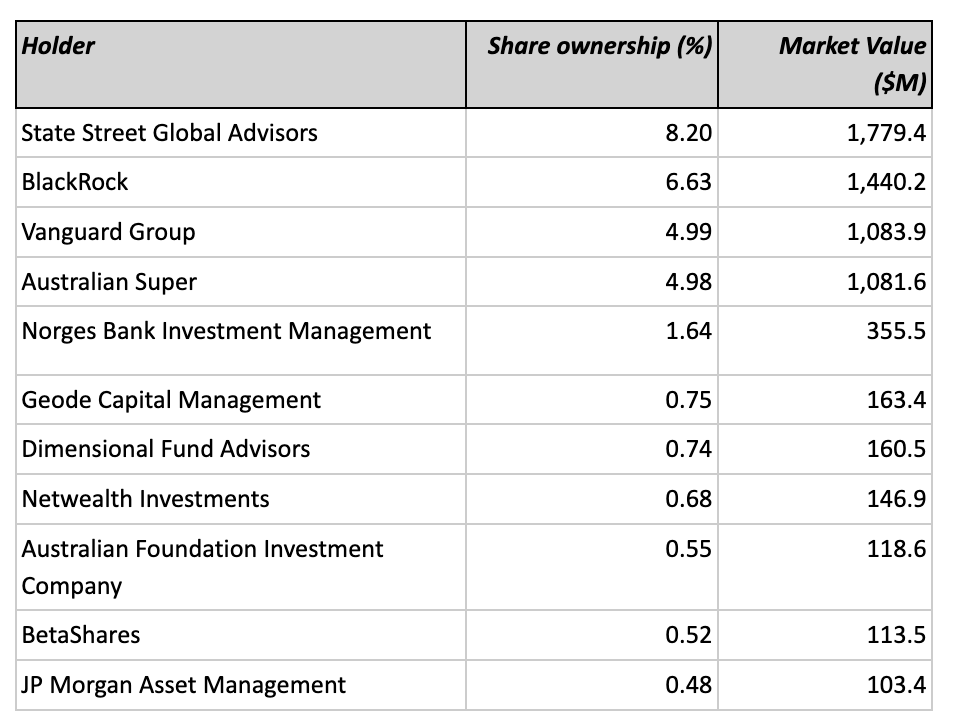
For example, these were the top shareholders of Woolworths last year: a mix of pension funds, like Australian Super, Sovereign Wealth Funds, banks and asset managers (like Betashares and Blackrock) who often invest on behalf of those pension funds, insurers and banks.
True ownership is often very complex due to the myriad corporate structures, and Australia doesn’t require the ‘beneficial owners’ of these companies that own shares to be disclosed.
These investors must vote on thousands of resolutions every year, so they pay for advice from “proxy advisors” like Glass Lewis and ISS to provide recommendations on how to vote. So, we try to gain the support of proxy advisors for our resolutions as well.
Each of these organisations have different objectives, mandates, incentives, employees, cultures, national regulations, and outlooks. They all in theory share the same goal of maximising shareholder value, but in reality, there are many views on how to do that.
We spend a lot of the months leading up to the AGMs for our target companies writing presentations and briefs for different investors based on our research of what they think is important.
We try to contact these funds and people who work there just to get our issue on their radar. Unfortunately, this means I spend more time on LinkedIn than I’d like!
The AGM is exciting because we find out how many investors supported our resolutions! In our first year of doing this we found out at the Coles AGM that nearly 40% of shareholders supported our resolution demanding more transparency on their salmon sourcing that’s harming the Maugean skate. That’s a very satisfying outcome that helped us build pressure on the supermarkets to ditch their toxic salmon.
What first began with 100 individual shares supporting a resolution led to nearly 40% of the company’s shareholders agreeing with our message that the supermarkets need to do more - which sends a strong signal to the board to take accountability and act!
This shows the way that one person buying shares in a company can contribute to larger change.
Head to the SIX platform to learn more about our current campaigns on climate, nature and social justice.
Photo credit: Matt Hrkac.
Start your journey in ethical investing and make a positive impact as a shareholder.