
-p-1080.png)
How much of a difference does it make if you invest in a regular ETF versus an ethically screened one?
This blog is for you if you’re interested in responsibly investing to grow wealth and want to take advantage of the diversified portfolio an ETF can offer. It’s also for you if you’re someone who likes nerding out about ethical investing and knowing what’s really in your ETFs.
Don’t know where to start, or feeling crunched for time? Take advantage of the time the SIX team puts in instead! SIX users can utilise our ethical tags to filter ETFs and stocks by what matters to you (like renewable energy, recycling, or electric vehicles). And at the end of this blog you’ll see some of the ETFs that stood out - both in good and bad ways.

Over the last few years, the number of Australians who want to see their funds invested ethically has risen to an all-time high. A 2024 study showed 87% of us expect our banks, super funds and investment managers to invest our money ethically, and 65% of us would invest more if we knew it would have a positive effect on the world.1 The same study also showed that over three-quarters of respondents wanted to know what their money is invested in.
Exchange-traded funds (ETFs) have become a go-to for many due to the diversification they offer, particularly first-time or time-poor investors. But if you like knowing what your funds are going towards, it’s a lot harder to find out what an ETF is exposed to than a single company.
Specialised or thematic ETFs might invest in as few as 40 securities or stocks, whereas some ultra-diversified ETFs invest in 8,000 - which means finding out what an ETF invests in can be a fair bit of work. Figuring out what your money is doing across hundreds to thousands of companies is a daunting task, even for researchers.
Lots of fund managers now offer ETFs that are branded as ethical or environmentally and socially responsible - but there’s no universal criteria or rules about what can and can’t be included under these labels.
As a general rule, “ethical” investment options or ETFs promise to exclude stocks or company that fail certain negative screens (often fossil fuels, gambling, tobacco, and weapons).
Most ethical screening is based on a company’s revenue, not its policies. Using revenue is a popular approach - partly because it’s such a straightforward calculation. In this common approach, there are two different sets of screens: positive and negative. Negative screens look for “bad” activity, and positive for “good” activity. The strictness of the revenue screen can vary widely, although a 5% threshold is fairly common.
It’s important to remember that screens only tell you so much about what a company (or ETF) is making money from - because a lot of business activity isn’t categorised as positive or negative. There’s also varying definitions or cut-offs for these negative activities. For example, one ESG-themed ETF by State Street (ASX:E200) excluded thermal coal but not other fossil fuels - three of the top ten investments receiving significant revenue from mining (BHP, Wesfarmers and Woodside Energy).
So companies that fail negative screens don’t get in. Does that mean the ethical ETFs are full of companies that pass positive screens? The answer is: not usually.
The companies that some of these general responsible options were invested in mimicked the overall market about 90% of the time. Half of the top ten largest companies on the ASX are the big banks (CBA, Westpac, NAB, ANZ, and Macquarie) - and only one of the top ten (BHP) is excluded by standard screens. The ETFs modelled on the international markets are loaded with technology stocks (NVIDIA, Microsoft, Alphabet, Amazon, Apple and Meta), which also don’t qualify for the most common positive or negative screens.
This does make sense - ETFs are designed to be diversified, and their returns are usually benchmarked against the market. Fund managers want to give their clients good returns. But it also meant the criteria could sometimes feel like “if it doesn’t fail, it’s fine”, and that generalist ETFs started to seem the same. And that makes sense - because almost all the ETFs on the market are offered by the same few providers.2
Summing up data for ETFs is always a challenge for us - and one of the most difficult parts is finding the balance between ‘not enough information to give you a complete overview’ and ‘so much information it becomes an overwhelming and meaningless blur’. If an ETF held stocks in ninety-nine fossil fuel companies and one wind farm company, they’d have one “fossil fuel” tag and one “renewables” tag. On one hand, that’s technically accurate - but it doesn’t really represent how they’re invested. On the other hand, displaying a hundred tags for a single ETF is a nightmare - from both a data and user point of view.
The investment spread is also uneven; unless it’s specifically designed and marketed as an “equal weight” option, the vast majority of the ETF is usually concentrated into the top ten holdings. For example, there are multiple ETFs invested in the 200 largest ASX-listed stocks. The Betashares ASX200 ETF (ASX:A200) had 46.3% invested in the top ten holdings; for the BlackRock version (ASX:IOZ), it was 45.4%. (Based on unit allocation as at 1 December 2025; holdings and allocations may change at any time.)
Too much information is almost as bad as too little. We had to find a balance - to make sure we didn’t get so focused on the details that we risked losing sight of the big picture.
Looking at the top ten holdings in each ETF was a sweet spot. It was a quick way to see patterns - and it also showed you if this was a rinse and repeat investment strategy (replicating the market with the baddies taken out), or if there was a distinct mix of companies.
If you wanted to see your investments passing positive screens? This is where the thematic options really stood out.
Our positive and negative screens are colour-coded green and red, respectively. A neutral result stays grey. Looking at the market-based ETFs was often pretty lacking in colour - although there was more red than green. Analysing the generic ethical ETFs was mostly grey, with more pops of green (and still some red).
It was when we began dissecting the themed ETFs (like clean energy, healthcare, battery technology and lithium) that the screen lit up with green. That’s not to say they were perfect - many still had at least one red flag in the top ten investments - but you could see the difference.
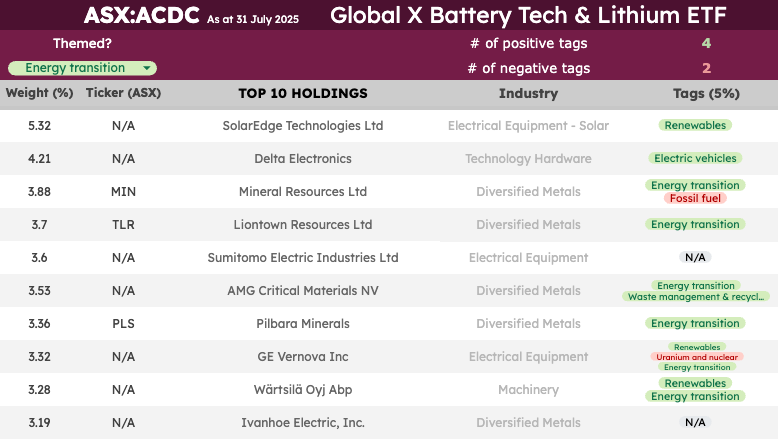
There’s still a clear difference between ETFs that are screened (even if only for the most egregious offenders) and the ones that aren’t. But if you want your funds invested with companies working towards their idea of a better future, it’s worth taking the time to look at your options - they’re not all made equal.
Based on investment allocations as at 31 July 2025. Investment holdings and asset allocations may change at any time.

1. From Values to Riches 2024: Charting consumer demand for responsible investing in Australia, Responsible Investment Association Australasia (RIAA), 2025.
Start your journey in ethical investing and make a positive impact as a shareholder.